Episode II of my XtraNormal series, "The Paragon."
Muffy, team captain to The Paragon, confronts Horn Dog after he misses the rescheduled team meeting. Horn Dog apparently has trouble with modern technology. Anyone who met Horn Dog in Episode I ("Horn Puppy & Crew Cuts") will have no trouble believing this.
Horn Dog: Technidiot
by: hermietheelf
Dear creators and writers of "Archer,"
Please feel free to find these episodes so uncontrollably hilarious that you contact me at bottomoftheglass@gmail.com and ask me if I would be interested in writing with you. Or, better, creating a show that came on after "Archer." Peace out, hippie.
Showing posts with label parents. Show all posts
Showing posts with label parents. Show all posts
Wednesday, September 28, 2011

Sunday, July 31, 2011
Man, Instinct, Risk, Stupidity
Fables - The Dodos (mp3)
Dark Turn of Mind - Gillian Welch (mp3)
“It’s definitely too rough out here for your brother.”
 One of the bigger indicators of gender is the inability to heed one’s own better wisdom. The better half has things called “mother’s instinct” or “women’s intuition,” and we act like this is because men don’t have the ability to foresee dangers or portend calamity.
But it’s not true. Men have tremendous intuition; they just ignore it.
Last week, after three days of overcast skies, three days of an oceanfront experience as if we were vacationing inside the caves of The Lost Sea, we were all desperate to squeeze out some cloudy time in the sand and sea. With my 3-year-old son on the shore building sand castles merely for the chance to stomp them, my daughters and I braved the testy tides. The choppy waves and strong undertow, tugging us northward, were great fun because they were just a bit risky.
My younger daughter, not quite yet 10, is the more cautious soul, and trepidation always accompanied her into the ocean. She’s a little too short and scrawny to fight the ocean pull, and she was having to work twice as hard to keep from drifting further away from us.
“I bet Turner will want to come out here,” she said. On our first day down, we had beaten the rain to the beach for a desperate hour of celebratory arrival swimming, and he had stayed glued to my shoulders or waist as we jumped waves. He'd loved it and been wigged out by it at the same time.
My response to her -- it's too rough for him -- was the right one. And it was obvious.
 Hardly had the words drifted away from my mouth in the word balloon than I heard him at the water’s edge, calling out to me. “Come get me, Daddy! I wanna go!”
Twenty minutes later, as I stumbled and wobbled back to shore, Turner screaming and fighting to spit out all that salty nastiness from his mouth, my daughters both laughed at how quickly I had ignored my own observations, and I could only shrug in resignation.
Something in dads, in men, in boys, is desperate to downplay risk. And it doesn’t even have to be a “risk/reward” calculation. The reward for taking Turner out into the torrents was low at best. I would receive no medals. My son wouldn’t “cherish this moment for the rest of his life.” My in-laws and wife wouldn’t look out on the waves, crashing in above our heads, and then tilt their heads adoringly at each other with that “Isn’t that the greatest dad alive?” look on their faces.
Yet there I was, picking up my small child, pulling him into my waist and chest, and trudging out into the foamy tuggy waters.
I could have said no. He might have pouted or objected briefly, but I’m not the kind of dad who worries about that stuff. I render my children painfully disappointed and pouty all the time and never think twice about it.
But I wanted us out there, together, doing something a little risky and stupid and fun. No defense attorney, no psychologist in the world could rightly defend me.
 We hadn’t gone 20 yards into the water when my decision paid off. A wave hit us so intensely that it buckled my knees, and I barely managed to prevent our mouths from taking in ocean. Turner thought it was hilarious, which made me proud and giddy. This was all the reward I was to receive. Soon after, a wave that seemed to curve at least three feet above my noble leap slammed into us, and it took intense focus to keep any kind of balance while keeping hold of my son.
As I recovered, and as I tried tending to his drenched face and screaming panic, I'd barely even cleared the water from my own eyes when another wave hit us full force, knocking me to my knees and Turner briefly under the water. This second attack did us in, and he was (understandably) inconsolable.
The reward for ignoring my instincts? A son it would take two days to coax and coddle back into the ocean.
Oh yeah, and that first wave knocked the glasses off my face. Didn't even know it until I got back to shore. I spent the rest of my vacation with only a pair of prescription sunglasses. Until I can get an eye appointment, I either wear my sunglasses at night, or I view the world in a strange blur.
Yay me and my instincts.
Dark Turn of Mind - Gillian Welch (mp3)
“It’s definitely too rough out here for your brother.”
 One of the bigger indicators of gender is the inability to heed one’s own better wisdom. The better half has things called “mother’s instinct” or “women’s intuition,” and we act like this is because men don’t have the ability to foresee dangers or portend calamity.
But it’s not true. Men have tremendous intuition; they just ignore it.
Last week, after three days of overcast skies, three days of an oceanfront experience as if we were vacationing inside the caves of The Lost Sea, we were all desperate to squeeze out some cloudy time in the sand and sea. With my 3-year-old son on the shore building sand castles merely for the chance to stomp them, my daughters and I braved the testy tides. The choppy waves and strong undertow, tugging us northward, were great fun because they were just a bit risky.
My younger daughter, not quite yet 10, is the more cautious soul, and trepidation always accompanied her into the ocean. She’s a little too short and scrawny to fight the ocean pull, and she was having to work twice as hard to keep from drifting further away from us.
“I bet Turner will want to come out here,” she said. On our first day down, we had beaten the rain to the beach for a desperate hour of celebratory arrival swimming, and he had stayed glued to my shoulders or waist as we jumped waves. He'd loved it and been wigged out by it at the same time.
My response to her -- it's too rough for him -- was the right one. And it was obvious.
 Hardly had the words drifted away from my mouth in the word balloon than I heard him at the water’s edge, calling out to me. “Come get me, Daddy! I wanna go!”
Twenty minutes later, as I stumbled and wobbled back to shore, Turner screaming and fighting to spit out all that salty nastiness from his mouth, my daughters both laughed at how quickly I had ignored my own observations, and I could only shrug in resignation.
Something in dads, in men, in boys, is desperate to downplay risk. And it doesn’t even have to be a “risk/reward” calculation. The reward for taking Turner out into the torrents was low at best. I would receive no medals. My son wouldn’t “cherish this moment for the rest of his life.” My in-laws and wife wouldn’t look out on the waves, crashing in above our heads, and then tilt their heads adoringly at each other with that “Isn’t that the greatest dad alive?” look on their faces.
Yet there I was, picking up my small child, pulling him into my waist and chest, and trudging out into the foamy tuggy waters.
I could have said no. He might have pouted or objected briefly, but I’m not the kind of dad who worries about that stuff. I render my children painfully disappointed and pouty all the time and never think twice about it.
But I wanted us out there, together, doing something a little risky and stupid and fun. No defense attorney, no psychologist in the world could rightly defend me.

As I recovered, and as I tried tending to his drenched face and screaming panic, I'd barely even cleared the water from my own eyes when another wave hit us full force, knocking me to my knees and Turner briefly under the water. This second attack did us in, and he was (understandably) inconsolable.
The reward for ignoring my instincts? A son it would take two days to coax and coddle back into the ocean.
Oh yeah, and that first wave knocked the glasses off my face. Didn't even know it until I got back to shore. I spent the rest of my vacation with only a pair of prescription sunglasses. Until I can get an eye appointment, I either wear my sunglasses at night, or I view the world in a strange blur.
Yay me and my instincts.
Monday, June 20, 2011
What Do You Want to Be When You Grow Up?
Forever My Father - Go Radio (mp3)
 We’re asked the question innumerable times as kids and teens. We’re constantly asking ourselves this awful trap of a question from the minute we begin to grasp that yes, one day, we will actually grow up and become our own versions of the old people we see sulking around us, bossing us around, stressing out over tire pressure and leaving the house on time and carping about some coworker named Hanrahan.
Unlike having my wisdom teeth pulled or my first kiss or the first time I dove off the high dive, I don’t recall much about the moment I actually realized I would become a grown-up.
Maybe it happened the way the whole Santa Claus bubble burst, which is to say gradually in such tiny increments that I don’t know the day it began so much as I know the day I couldn’t go back. It wasn’t until my college years when I saw my own mom crumble into pieces as she dealt with the death of her own parents that I knew I couldn’t remain a child.
My mom kept this cool pre-fabricated booklet that chronicled my elementary school years. In addition to a folder for pictures and keepsakes, it included a list of factoids (height, weight) and blanks. “Favorite sport,” “Favorite book,” and the aforementioned “What I want to be when I grow up.”
 In second grade, I wanted to be a baseball player. I had moved up from catcher in first grade to second baseman, a huge leap forward in baseball evolution. Modern people don’t know this, but in my day, the catcher on a first grade team had to sit in a little box several feet back behind home plate. No mask. No big cool mitt. Just stand in the corner and wait for foul balls. And, if you caught a foul, the batter was out.
So basically, the catcher was for the kid who couldn’t play anything, and the catcher’s only job was to be the asshole who broke the heart of players on the other team. So a move up to second base was kind of a big deal.
In third grade, I wanted to be a priest. The only two denominations I’d ever known to that point were Baptist and Presbyterian, and neither of them had jack squat to do with priests. But I was at this new school, Lutheran School, and their religion seemed really intense and formal compared to mine. That's my best guess.
And so on with fourth grade (football player!) and fifth grade (fireman!) and sixth grade (fireman again!).
 And then I moved up to junior high, and I stopped filling out those surveys because the book ended. And I went to a school with all boys, so we stopped playing those games where you fold paper into funky origami shapes and predict your future and your girlfriend. And we stopped playing any and all games where the point was to find love or romance, because we were too busy playing games where actual points were scored using spherical objects of some size or another.
I’m not saying I stopped thinking about the future just because I went to a boys school. But it certainly decreased greatly in frequency, and I stopped talking about it. Even late night sleepovers with friends rarely involved talk of adulthood. We were too busy wondering whether Jean Gray and Scott Summers ever actually did it or playing a 12th-level paladin or 7th-level dwarf. Talk of romance and adventure always revolved around the characters we created, not ourselves.
By eighth grade, even if the words never passed my lips, all I knew for certain was that I wanted to be a dad someday. I knew it so intensely that I took it for granted. Nobody talked about it. I think most of us assumed it was just going to happen, that it was part of growing up. Circle of life yada yada.
In fact, I more specifically remember my friend Scott proclaiming he didn’t want kids. He said he didn’t want kids because he was so scared he would screw them up, because he felt so screwed up himself. And I remember being so scared, because I wanted to be a sympathetic friend, but I was also horrified that his opposition might be contagious, and I couldn’t have this particular desire taken from me.
 Even though I spent most of my adolescent life feeling like the garbage monster from Star Wars, my desperate awkwardness never wrecked my warped certainty that I would be a good and loving father.
The only obstacle I ever saw that would prevent my fatherhood was the need to find some woman foolish and desperate enough to see me as a worthy mate and partner. That part was in question right up to the point where the preacher said I could kiss her and walk out of the church as husband and wife, and there were times after that when I was pretty sure it was all just a dream from Dallas.
Fatherhood has had some crap days. I’ve had days when I wanted to flush my own head down the toilet rather than listen to my daughter whine or attempt to negotiate with my son during a demonic temper tantrum. But the crappiest days are the days I’ve gone to sleep feeling like a failure father, when my own flaws and shortcomings and failings bleed into the lives of those wonderful creatures who share my blood and my roof.
 I never thought my parents were perfect, and I never expected parental perfection of myself. I just want to be “good enough” or maybe just a smidge better.
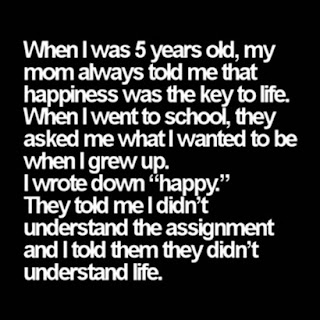
For better or worse, Happiness was never my parental goal*. A sense of purpose and meaning, a sense of responsibility, and the comfort to know that I will love them no matter their flaws or their failures yet demand and expect that they always yearn to improve.
I can’t help but believe if they have these things -- purpose, responsibility, love, drive -- they’ll find joy more often than not.
* -- The latest Atlantic parenting-related article (“How To Land Your Kid In Therapy”) is so exciting for parents like me to read, because it validates our fear that too many parents are too involved, too controlling, too insistent that everything in their child’s life be like Candyland instead of like Sorry!
** -- The T-shirt text on the right is a bunch of shit, because happiness is not a fish you can catch or some pet hamster you can simply buy and keep.

Unlike having my wisdom teeth pulled or my first kiss or the first time I dove off the high dive, I don’t recall much about the moment I actually realized I would become a grown-up.
Maybe it happened the way the whole Santa Claus bubble burst, which is to say gradually in such tiny increments that I don’t know the day it began so much as I know the day I couldn’t go back. It wasn’t until my college years when I saw my own mom crumble into pieces as she dealt with the death of her own parents that I knew I couldn’t remain a child.
My mom kept this cool pre-fabricated booklet that chronicled my elementary school years. In addition to a folder for pictures and keepsakes, it included a list of factoids (height, weight) and blanks. “Favorite sport,” “Favorite book,” and the aforementioned “What I want to be when I grow up.”

So basically, the catcher was for the kid who couldn’t play anything, and the catcher’s only job was to be the asshole who broke the heart of players on the other team. So a move up to second base was kind of a big deal.
In third grade, I wanted to be a priest. The only two denominations I’d ever known to that point were Baptist and Presbyterian, and neither of them had jack squat to do with priests. But I was at this new school, Lutheran School, and their religion seemed really intense and formal compared to mine. That's my best guess.
And so on with fourth grade (football player!) and fifth grade (fireman!) and sixth grade (fireman again!).

I’m not saying I stopped thinking about the future just because I went to a boys school. But it certainly decreased greatly in frequency, and I stopped talking about it. Even late night sleepovers with friends rarely involved talk of adulthood. We were too busy wondering whether Jean Gray and Scott Summers ever actually did it or playing a 12th-level paladin or 7th-level dwarf. Talk of romance and adventure always revolved around the characters we created, not ourselves.
By eighth grade, even if the words never passed my lips, all I knew for certain was that I wanted to be a dad someday. I knew it so intensely that I took it for granted. Nobody talked about it. I think most of us assumed it was just going to happen, that it was part of growing up. Circle of life yada yada.
In fact, I more specifically remember my friend Scott proclaiming he didn’t want kids. He said he didn’t want kids because he was so scared he would screw them up, because he felt so screwed up himself. And I remember being so scared, because I wanted to be a sympathetic friend, but I was also horrified that his opposition might be contagious, and I couldn’t have this particular desire taken from me.
 Even though I spent most of my adolescent life feeling like the garbage monster from Star Wars, my desperate awkwardness never wrecked my warped certainty that I would be a good and loving father.
The only obstacle I ever saw that would prevent my fatherhood was the need to find some woman foolish and desperate enough to see me as a worthy mate and partner. That part was in question right up to the point where the preacher said I could kiss her and walk out of the church as husband and wife, and there were times after that when I was pretty sure it was all just a dream from Dallas.
Fatherhood has had some crap days. I’ve had days when I wanted to flush my own head down the toilet rather than listen to my daughter whine or attempt to negotiate with my son during a demonic temper tantrum. But the crappiest days are the days I’ve gone to sleep feeling like a failure father, when my own flaws and shortcomings and failings bleed into the lives of those wonderful creatures who share my blood and my roof.
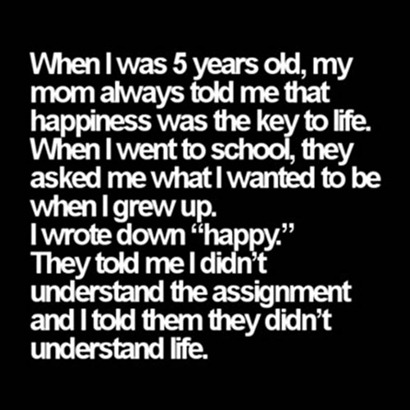
For better or worse, Happiness was never my parental goal*. A sense of purpose and meaning, a sense of responsibility, and the comfort to know that I will love them no matter their flaws or their failures yet demand and expect that they always yearn to improve.
I can’t help but believe if they have these things -- purpose, responsibility, love, drive -- they’ll find joy more often than not.
* -- The latest Atlantic parenting-related article (“How To Land Your Kid In Therapy”) is so exciting for parents like me to read, because it validates our fear that too many parents are too involved, too controlling, too insistent that everything in their child’s life be like Candyland instead of like Sorry!
** -- The T-shirt text on the right is a bunch of shit, because happiness is not a fish you can catch or some pet hamster you can simply buy and keep.
Saturday, April 9, 2011
The Sins of the Son
Strange Days - Matthew Good Band (mp3)
 EXHIBIT A:
The Philadelphia Enquirer recently wrote a powerful 7-part series about violence and schools called “Assault on Learning.” Part Five was titled “Young and Violent, Even Kindergarteners.” Here’s the introduction:
 EXHIBIT B:
Meanwhile, in Chattanooga, Jesse Mathews shot and killed -- shot in the head at close range -- a police officer who had the unmitigated gall to attempt to taze Jesse after a foiled armed robbery attempt. Jesse emerged yesterday from a medically-induced coma. We revived him just so we can spend millions of dollars to kill him later.
In the meantime, Mathews was a parole jumper from Colorado with a nice string of recent robberies under his belt. The FBI has since arrested both of his parents, his sister, and his sister’s boyfriend, all of whom helped Jesse procure weapons and harbored him and paid to keep him away from the arm of the law.
Go read that story. It’s quite the Addams Family they have going, these Mathews people.
 EXHIBIT C:
All over this great country of ours, teachers are having to fight for every ounce of respect they can get. Unions are being busted, pay ain’t increasing, benefits are being cut, and experts and politicians are demanding “accountability” for those who earn money through educating kids.
“Fixing” teachers is the cornerstone of fixing the problem of education in this country, they say.
CONCLUSION:
I dare you, absolutely dare you, to go read that Philadelphia Enquirer series and that Chattanoogan.com article and have the unmitigated gall to continue insisting that teachers are the cornerstone of a child’s education. You don’t have to be a Tiger Mother to know that parents -- often a Single Mother -- is the single biggest obstacle to improving education across this country.
Parenting, when done right, is one of the hardest, most agonizing, most stressful professions in the world. But it ain’t rocket science. It requires time and devotion, but it doesn’t require a doctorate or scads of intelligence. Just commitment and conviction.
When I look around at these stories in the news about kids and young adults wrapped up in criminal activity, what I see are stories about kids with sh*tty, neglectful, abusive parents.
And usually it’s just one parent, because the man usually drops his seed, earns some kid with his name, and then disappears into the ether of some other woman’s bedroom to repeat the process a few more times. The man is sh*tty, neglectful and abusive by disappearing and taking no responsibility. The woman is left alone to clean up, except she’s often too young, too stupid, or too overwhelmed to do it, and the consequence is that she often becomes sh*tty, neglectful and abusive.
You want to fix education? Go after sh*tty parents with every ounce and every dollar of reform you can. You want to reform prison? Punish parents for the criminal transgressions of their children.
 Am I being Draconian and unsympathetic? Hell no. Not to the kids I’m not. Not to the young adults who are raised in households like Jesse Mathews must have been, with parents who kill people in botched robberies, who buy their felon relatives guns and bullet-proof vests, who make a living by dodging the law as one big happy family.
You want to prevent Jesse Mathews? Prevent his parents. Prevent them, or if you can’t prevent them, bring an unholy hammer of Thor down on their f**king skulls when their child proves them incompetent.
Let me get this right. A 25-year-old could go into a bar, drink 20 shots, drive into a family on the highway, and that bar can be held responsible in part for the tragedy, but a 25-year-old f**knut raised in an incompetent or abusive household shoots a family, and the parents aren’t the least bit at fault?? Yeah, that makes perfect sense. Blame a bar for 30 minutes of neglect, but hold parents blameless for 20 years of neglect.
Are there good and committed parents whose children fall and stray and end up criminals despite their best intents? Abso-friggin’-lutely. But these theoretical parents are vastly, VASTLY, less significant in their percentages than committed and good teachers whose students can’t pass a state-issued bubble sheet, and we sure don’t seem hesitant to want to bring down the hammer on those people, much less pay them anything for their troubles.
You want justice? You want fairness? You want a better future? It’s time we started talking about enforcing a new level of justice and scrutiny on parents. Too many have gotten away with too little for too long.

The Philadelphia Enquirer recently wrote a powerful 7-part series about violence and schools called “Assault on Learning.” Part Five was titled “Young and Violent, Even Kindergarteners.” Here’s the introduction:
Tabitha Allen blames herself for her 10-year-old son's violent behavior.
Growing up and living in a drug-infested, hooker-inhabited neighborhood, the 33-year-old mother of five is angry about life.
"My anger reflects off my children," Allen explained one morning in the North Philadelphia rowhouse she inherited from her grandmother. Her son - a thin, almost gaunt, boy with long eyelashes - punched a teacher last June at Kenderton Elementary School, a K-8 in Tioga. He knocked the glasses off her face and blackened her eye with a blow that packed unexpected power.
As a 10-year-old, he had reached the minimum age to be arrested, and ended up with a simple assault charge in Family Court, where he was put on probation. He was removed from Kenderton and transferred to a classroom for disruptive elementary school students in Logan.
Meanwhile, in Chattanooga, Jesse Mathews shot and killed -- shot in the head at close range -- a police officer who had the unmitigated gall to attempt to taze Jesse after a foiled armed robbery attempt. Jesse emerged yesterday from a medically-induced coma. We revived him just so we can spend millions of dollars to kill him later.
In the meantime, Mathews was a parole jumper from Colorado with a nice string of recent robberies under his belt. The FBI has since arrested both of his parents, his sister, and his sister’s boyfriend, all of whom helped Jesse procure weapons and harbored him and paid to keep him away from the arm of the law.
Go read that story. It’s quite the Addams Family they have going, these Mathews people.

All over this great country of ours, teachers are having to fight for every ounce of respect they can get. Unions are being busted, pay ain’t increasing, benefits are being cut, and experts and politicians are demanding “accountability” for those who earn money through educating kids.
“Fixing” teachers is the cornerstone of fixing the problem of education in this country, they say.
CONCLUSION:
I dare you, absolutely dare you, to go read that Philadelphia Enquirer series and that Chattanoogan.com article and have the unmitigated gall to continue insisting that teachers are the cornerstone of a child’s education. You don’t have to be a Tiger Mother to know that parents -- often a Single Mother -- is the single biggest obstacle to improving education across this country.
Parenting, when done right, is one of the hardest, most agonizing, most stressful professions in the world. But it ain’t rocket science. It requires time and devotion, but it doesn’t require a doctorate or scads of intelligence. Just commitment and conviction.
When I look around at these stories in the news about kids and young adults wrapped up in criminal activity, what I see are stories about kids with sh*tty, neglectful, abusive parents.
And usually it’s just one parent, because the man usually drops his seed, earns some kid with his name, and then disappears into the ether of some other woman’s bedroom to repeat the process a few more times. The man is sh*tty, neglectful and abusive by disappearing and taking no responsibility. The woman is left alone to clean up, except she’s often too young, too stupid, or too overwhelmed to do it, and the consequence is that she often becomes sh*tty, neglectful and abusive.
You want to fix education? Go after sh*tty parents with every ounce and every dollar of reform you can. You want to reform prison? Punish parents for the criminal transgressions of their children.
 Am I being Draconian and unsympathetic? Hell no. Not to the kids I’m not. Not to the young adults who are raised in households like Jesse Mathews must have been, with parents who kill people in botched robberies, who buy their felon relatives guns and bullet-proof vests, who make a living by dodging the law as one big happy family.
You want to prevent Jesse Mathews? Prevent his parents. Prevent them, or if you can’t prevent them, bring an unholy hammer of Thor down on their f**king skulls when their child proves them incompetent.
Let me get this right. A 25-year-old could go into a bar, drink 20 shots, drive into a family on the highway, and that bar can be held responsible in part for the tragedy, but a 25-year-old f**knut raised in an incompetent or abusive household shoots a family, and the parents aren’t the least bit at fault?? Yeah, that makes perfect sense. Blame a bar for 30 minutes of neglect, but hold parents blameless for 20 years of neglect.
Are there good and committed parents whose children fall and stray and end up criminals despite their best intents? Abso-friggin’-lutely. But these theoretical parents are vastly, VASTLY, less significant in their percentages than committed and good teachers whose students can’t pass a state-issued bubble sheet, and we sure don’t seem hesitant to want to bring down the hammer on those people, much less pay them anything for their troubles.
You want justice? You want fairness? You want a better future? It’s time we started talking about enforcing a new level of justice and scrutiny on parents. Too many have gotten away with too little for too long.
Wednesday, April 6, 2011
Mea Culpa, Tiger Mother
Rains in Asia - Jump, Little Children (mp3)
I Tried - Jess Klein (mp3)
 Roughly three months ago, I wrote a fairly damning screed against Amy Chua, a.k.a. “The Tiger Mother.” An excerpt from her memoir Battle Hymn of the Tiger Mother had been published in the Wall Street Journal, and the Western parenting world had begun to unleash holy hell on her. I was happy to jump on board her angry mob.
My, how three months can change things.
In the following days, information came out suggesting that Chua’s book and her humanity were both more worthy of consideration than originally thought, and I added a concluding editorial note to my blog to suggest as much.
Last month, I attended the screening of a super-popular eduwonky documentary called Race to Nowhere in the middle of high class Atlanta, and that experience drove me to purchase and actually read Chua’s book, which I finished this week.
I owe Mrs. Chua a ginormous apology.
 Her short, easily-read personal account of trying to raise two children in a way honoring her culture and her own childhood, an account of success and failure, of being incurably snotty and egotistical, of being agonizingly brilliant and demanding, of being the kind of woman who would stab me several dozen times were she to have to live with me, deserves every dollar it’s made in sales and hype. It’s been several years since I’ve read a non-fiction book that so desperately deserved to be discussed in an intelligent book group.
In dozens of places, Chua is self-deprecating. But because her entire persona and character is of The Impenetrable and Unfeeling Chinese Tiger Mother, the reader has to be willing to read between the lines and see the human behind the book, typing these descriptions of herself, in order to see this.
Even more challenging, we have to get past our judgment and defensiveness about parenting, past our judgment of those who proudly hold themselves and their ways above us and ours.
As I read the book, Chua reminded me of a bully. An intellectual bully, or a parenting bully, any kind of bully whose own insecurities are projected through anger or intimidation. But I think she knows this about herself. I also think she intentionally created a slightly exaggerated version of herself -- one that was a little more overconfident and unfeeling -- for most of the book so as to build up her place as the book’s semi-secret bad guy.
On page 54, Amy describes her husband’s upbringing. It is, in all ways, the Perfect Western Nightmare in the eyes of any Tiger Mother. His parents believed in space and freedom and choice. His parents were divorced. He was encouraged to be creative and question authority. By Chua’s own account, this kind of upbringing should have resulted in a homeless man or a serial killer, but instead Jed is a Yale law professor and novelist and is by any reasonable standard a disgustingly nauseatingly successful guy. Not only that, but he’s a guy who despite being very pasty white and Jewish somehow earned Chua’s own heart.
This, I thought, was her early subtle admission that The Chinese Way was not necessarily The Only Perfect Way. Yet she trudges on with her own path. Which creates much better dramatic irony.
 Not to bead a dead analogy, but Chua created in her own character of The Mother -- either intentionally or truthfully -- a very contemporary Western anti-hero. Think Vic Mackey or Tony Soprano or Don Draper or Walter White, people whose flaws are huge and festering and exposed for the world to judge, people we are drawn to because our everyday lives are surrounded by people who are guarded and closed off and refuse to reveal their imperfect-ness to us, and because we ourselves insist on pretending we are closer to perfect than we know ourselves to be.
She might truly be a proud and egotistical lady. She certainly has enough notches of professional and familial success in her belt to have earned a little of it. All the more amazing that she was willing to expose herself as nakedly as she has in this book.
By the end, as her world unravels a little, I found myself very moved. It didn’t get me crying, but I had a few short breaths here and there. My head said she deserved the come-uppance she was getting, but my heart saw the flawed human, the hopeful parent, the bag of inconsistent bones we all are, and I wanted to reach out and hug her.
Battle Hymn of the Tiger Mother is an amazing accomplishment, and if you are a loving parent of any culture, or an educator, or in any way deal with kids or their stinkin’ parents, this book is worth consideration.
I Tried - Jess Klein (mp3)

My, how three months can change things.
In the following days, information came out suggesting that Chua’s book and her humanity were both more worthy of consideration than originally thought, and I added a concluding editorial note to my blog to suggest as much.
Last month, I attended the screening of a super-popular eduwonky documentary called Race to Nowhere in the middle of high class Atlanta, and that experience drove me to purchase and actually read Chua’s book, which I finished this week.
I owe Mrs. Chua a ginormous apology.

In dozens of places, Chua is self-deprecating. But because her entire persona and character is of The Impenetrable and Unfeeling Chinese Tiger Mother, the reader has to be willing to read between the lines and see the human behind the book, typing these descriptions of herself, in order to see this.
Even more challenging, we have to get past our judgment and defensiveness about parenting, past our judgment of those who proudly hold themselves and their ways above us and ours.
As I read the book, Chua reminded me of a bully. An intellectual bully, or a parenting bully, any kind of bully whose own insecurities are projected through anger or intimidation. But I think she knows this about herself. I also think she intentionally created a slightly exaggerated version of herself -- one that was a little more overconfident and unfeeling -- for most of the book so as to build up her place as the book’s semi-secret bad guy.
On page 54, Amy describes her husband’s upbringing. It is, in all ways, the Perfect Western Nightmare in the eyes of any Tiger Mother. His parents believed in space and freedom and choice. His parents were divorced. He was encouraged to be creative and question authority. By Chua’s own account, this kind of upbringing should have resulted in a homeless man or a serial killer, but instead Jed is a Yale law professor and novelist and is by any reasonable standard a disgustingly nauseatingly successful guy. Not only that, but he’s a guy who despite being very pasty white and Jewish somehow earned Chua’s own heart.
This, I thought, was her early subtle admission that The Chinese Way was not necessarily The Only Perfect Way. Yet she trudges on with her own path. Which creates much better dramatic irony.

She might truly be a proud and egotistical lady. She certainly has enough notches of professional and familial success in her belt to have earned a little of it. All the more amazing that she was willing to expose herself as nakedly as she has in this book.
By the end, as her world unravels a little, I found myself very moved. It didn’t get me crying, but I had a few short breaths here and there. My head said she deserved the come-uppance she was getting, but my heart saw the flawed human, the hopeful parent, the bag of inconsistent bones we all are, and I wanted to reach out and hug her.
Battle Hymn of the Tiger Mother is an amazing accomplishment, and if you are a loving parent of any culture, or an educator, or in any way deal with kids or their stinkin’ parents, this book is worth consideration.
Sunday, January 30, 2011
We Become Our Parents
Ariel Pink's Haunted Graffiti--"Can't Hear My Eyes" (mp3)
Donnie Iris--"I Can't Hear You" (mp3)
 My wife and I left a "concert" event at intermission on Saturday night. It's a student-performance show that we have enjoyed for the past three years, but this year, we just weren't feeling it. Why? Because we couldn't quite hear it.
Donnie Iris--"I Can't Hear You" (mp3)
 My wife and I left a "concert" event at intermission on Saturday night. It's a student-performance show that we have enjoyed for the past three years, but this year, we just weren't feeling it. Why? Because we couldn't quite hear it.
No, it wasn't because our joint hearing is shot, though it is headed in that direction. Instead, the kids behind us just would not shut up. We got there about 15 minutes before the show started, and that left us with a choice of seats in the upper third of the auditorium. Little did I know that that is where all of the middle school children sit.
And that's when we became our parents. It's not a role that I enjoy playing. But play it I did.
Ears did have something to do with it. When you get older, your ears, even if they haven't been abused at rock concerts like mine, are not as good at distinguishing between noises coming from different sources. When you can't hear something that you think you should be able to hear, it makes you feel anxious and isolated.
 So we became our parents in two ways: 1) we turned around and asked the children to be quiet and 2) previous to that occurrence, the wife looked repeatedly at her husband with the expectation that he would be the one to take care of it. Nevermind that the wife in question is a litigator who spends her days (and nights, debriefing) in confrontation and conflict, while said husband has established himself in his school in a very comfortable "good cop" role.
The husband-wife interplay built until after the second performance. The wife kept looking at the husband--when was he finally going to do something about the incessant talking going on behind them? And so, yet another example of the greatest motivator of man since time began kicked in--the gaze of wife drove husband to act. So the husband turned around, tapped the knee of a boy from his school in lieu of the many chattering girls surrounding (thus keeping this as a social agreement among men) and said, "You're not going to talk non-stop the whole time, are you?"
Ears did have something to do with it. When you get older, your ears, even if they haven't been abused at rock concerts like mine, are not as good at distinguishing between noises coming from different sources. When you can't hear something that you think you should be able to hear, it makes you feel anxious and isolated.
So we became our parents in two ways: 1) we turned around and asked the children to be quiet and 2) previous to that occurrence, the wife looked repeatedly at her husband with the expectation that he would be the one to take care of it. Nevermind that the wife in question is a litigator who spends her days (and nights, debriefing) in confrontation and conflict, while said husband has established himself in his school in a very comfortable "good cop" role.The husband-wife interplay built until after the second performance. The wife kept looking at the husband--when was he finally going to do something about the incessant talking going on behind them? And so, yet another example of the greatest motivator of man since time began kicked in--the gaze of wife drove husband to act. So the husband turned around, tapped the knee of a boy from his school in lieu of the many chattering girls surrounding (thus keeping this as a social agreement among men) and said, "You're not going to talk non-stop the whole time, are you?"
You'd have thought I reached above his head and pulled the string attached to the lightbulb above it, so shocked was he to have to embrace the idea that he was making too much noise. And he did stop talking. Sort of. For awhile. And not nearly as much.
Me, sensitive to children's issues as part of my life for the past 27 years, immediately flashing back to a moment in my own middle school when our French teacher had the very bad idea of taking all of us to an evening performance of Le Bourgeois Gentilhomme, a well-known Moliere play that not only had we not read in English but that, as middle schoolers, did not even begin to be able to comprehend in French. So we were antsy and crammed into tight seats and chatty and fidgety and when my friend Mark, sitting next to me, decided to put his right foot up on his left knee for a change of position, I was having none of any invasion into my space, and so I shoved his foot, causing it to kick the woman in front of him in the head. That she only turned around and let us have it but didn't go get the manager and never told our French teacher is one of the great miracles of my life.
 And I also glanced over at my daughter and her friends, several seats and a couple of rows below us, and noticed that every time I checked, they also were talking pretty much non-stop.
My male friend behind me wasn't having much luck either. Chastened by me, he had really toned down his talking, but that had had no affect on all of the girls surrounding him that he was trying to navigate, and so perhaps he sat there, mostly miserably or using sign language, while they continued with the multitude of things that needed to be said while one performer after another took the stage. I didn't have any intention of telling him that it was not going to get any easier, that navigation.
Me, sensitive to children's issues as part of my life for the past 27 years, immediately flashing back to a moment in my own middle school when our French teacher had the very bad idea of taking all of us to an evening performance of Le Bourgeois Gentilhomme, a well-known Moliere play that not only had we not read in English but that, as middle schoolers, did not even begin to be able to comprehend in French. So we were antsy and crammed into tight seats and chatty and fidgety and when my friend Mark, sitting next to me, decided to put his right foot up on his left knee for a change of position, I was having none of any invasion into my space, and so I shoved his foot, causing it to kick the woman in front of him in the head. That she only turned around and let us have it but didn't go get the manager and never told our French teacher is one of the great miracles of my life.
 And I also glanced over at my daughter and her friends, several seats and a couple of rows below us, and noticed that every time I checked, they also were talking pretty much non-stop.
My male friend behind me wasn't having much luck either. Chastened by me, he had really toned down his talking, but that had had no affect on all of the girls surrounding him that he was trying to navigate, and so perhaps he sat there, mostly miserably or using sign language, while they continued with the multitude of things that needed to be said while one performer after another took the stage. I didn't have any intention of telling him that it was not going to get any easier, that navigation.
Until intermission.
One of the beauties of marriage, cultivated over years together, is that without having said a word, without have expressed a discontent or sulked silently, both of you stand up at intermission and know that you have had enough and that you are leaving. So it was with us. We were not angry or upset; we had just had enough.
We drifted slowly, without apparent sense of purpose, toward the door. And, I suppose, that is a bit of our parents, too, that realization that no social outing is all that important, that it's just as comforting and satisfying to smile your goodbyes and walk out the door towards something else. Whatever happened that we had missed, we would hear about it. That would be enough.
One of the beauties of marriage, cultivated over years together, is that without having said a word, without have expressed a discontent or sulked silently, both of you stand up at intermission and know that you have had enough and that you are leaving. So it was with us. We were not angry or upset; we had just had enough.
We drifted slowly, without apparent sense of purpose, toward the door. And, I suppose, that is a bit of our parents, too, that realization that no social outing is all that important, that it's just as comforting and satisfying to smile your goodbyes and walk out the door towards something else. Whatever happened that we had missed, we would hear about it. That would be enough.
Thursday, January 27, 2011
A Softer Place to Fall
The Most - Lori McKenna (mp3)
Pieces of Me - Lori McKenna (mp3)
 In a Jasper, Tennessee, kitchen roughly half the size of my office, my grandmother once fixed meals for her husband and seven children. I don’t have the foggiest notion where they all ate. Maybe at some dinner table on the roof. They sure didn’t have space in that house for a 7-person dining table.
Carrie was a red-headed firebrand in her younger years, but she’d gone shock-white by the time I knew her. While pictures in albums prove that she on occasion wore a nice dress, I can only recall her wearing flimsy or flannel housegowns and slippers. While she milled around the entire house, I can only recall her in that kitchen, busying herself over a pot, or over the sink, or over the counter. She was either working to serve someone a meal or working to escape the rest of the house and family. Or both.
When I listen to Lori McKenna, I think of my grandmother.
 My grandfather was deaf in one ear by the time I met him. Their phone had a volume dial on it, which I always played with once I’d tired of my Star Wars figures. The rare times he was in the house instead of out in the community or tending obsessively to his two gardens on two separate plots of land, he was sitting in a flimsy rocker-recliner and gnawing on a plug of tobacco. Spittoons and their smells don’t erase easily from a child’s memories.
From all indications, my grandfather was exactly everything a wise soul would expect out of a influential figure with a charismatic charm: adored, adulated, admired, and, at least occasionally, adulterous.
Yeah, that last one I didn’t know about until I was in my 20s, a year or two after my grandmother had died. It took another decade to truly grasp it, that my grandfather had fathered a child out of wedlock, that my grandmother knew of this, that she continued cooking meals in that kitchen for seven children and her preacher husband. That she kept living, kept smiling, kept moving.
A few years ago, my mom showed me a collection of poems written by my grandmother. She kept them hidden in a small box, most of them written on the kinds of note cards usually reserved for family recipes. They closely followed Emily Dickinson in style and voice, quatrains full of dashes and simple rhyme schemes. Carefully written, words rarely crossed out, rarely if ever misspelled. Many about dying, about the struggle against meaninglessness, about the siren call of suicide, about feeling unloved and unappreciated.
 I imagine her writing those poems as she cooked a stew, or chopped tomatoes, or heated up the morning’s oatmeal. I’m certain she wrote most of them in her kitchen. And when she wasn’t writing them, they were growing like mustard seeds in her mind.
Neither her smiles and witty comments from the kitchen, nor her frightening and lost poems were false representations of her. We are all more complicated than even we, our own autobiographers, can fathom. She was both personae and many others, surely.
When I listen to Lori McKenna, I think of my grandmother.
My mother was the oldest of seven children. She married young, then married again rashly, and then married again carefully. Divorce, death and death split her from those three men. I’ll see her occasionally, staring into the distance of nothing, and I know she’s thinking about my father.
I hope that heaven has a movie theater where I’ll be able to go and watch the whole movie of my mother’s life with the benefit of my adult understanding. It might be a shocking tale, or maybe merely a quiet and endearing one, but I know nothing in that movie will make me love her less.
When I listen to Lori McKenna, I think of my mother.
I walked into my bedroom last night to see my flu-ridden middle child curled into my wife, both of them buried under our covers and chasing soccer balls and American Girl dolls in their synchronous dreams. My wife has been housebound all week with two sick children and a sick mother-in-law, and her husband comes home every night with some new whiny tale of work woe and soapbox monologues aimed at some unseen adversary.
 Her son woke up at 5:30 this morning with a nosebleed that first left its evidence all over his bed and with a trail from his room to ours. Her husband welcomed her home from her agonizing church meeting last night with a hug, a kiss, and a “I’m in there playing ‘Call of Duty.’ Gotta get back to it! By the way, the Tar Heels won! I’ll be in bed by midnight!”
When I listen to Lori McKenna, I think of my wife.
Lori McKenna has a new album, Lorraine. She has six albums. Her personal story is so endearing and worthy of its own novel that I can only just link to her own web site and encourage you to learn about her.
Her music need not be 100% autobiographical to be real. The feelings are real. The characters are real. The situations are real. Her music is my family and your family and anyone’s family that knows anything of cornbread or covered dishes, pick-up trucks or potholes. She is my grandmother, my mother, my wife, my friends. She is almost any woman with a yearning for more but a need to cling gratefully to the small good fortunes in her midst both past and present. She is everything I take for granted and cherish, everything worth crying for or fighting over.
Lori, can you feel me, down here in Tennessee, devouring your notes and twangs, feeding my hungry soul? Can you feel the hundreds or thousands of others who feel this connection without ever having met you? If so, I hope it warms and strengthens you and your family, because God knows you deserve it.
None of the pictures are of my family, my grandparents, or anyone related to me.
Pieces of Me - Lori McKenna (mp3)
 In a Jasper, Tennessee, kitchen roughly half the size of my office, my grandmother once fixed meals for her husband and seven children. I don’t have the foggiest notion where they all ate. Maybe at some dinner table on the roof. They sure didn’t have space in that house for a 7-person dining table.
Carrie was a red-headed firebrand in her younger years, but she’d gone shock-white by the time I knew her. While pictures in albums prove that she on occasion wore a nice dress, I can only recall her wearing flimsy or flannel housegowns and slippers. While she milled around the entire house, I can only recall her in that kitchen, busying herself over a pot, or over the sink, or over the counter. She was either working to serve someone a meal or working to escape the rest of the house and family. Or both.
When I listen to Lori McKenna, I think of my grandmother.

From all indications, my grandfather was exactly everything a wise soul would expect out of a influential figure with a charismatic charm: adored, adulated, admired, and, at least occasionally, adulterous.
Yeah, that last one I didn’t know about until I was in my 20s, a year or two after my grandmother had died. It took another decade to truly grasp it, that my grandfather had fathered a child out of wedlock, that my grandmother knew of this, that she continued cooking meals in that kitchen for seven children and her preacher husband. That she kept living, kept smiling, kept moving.
A few years ago, my mom showed me a collection of poems written by my grandmother. She kept them hidden in a small box, most of them written on the kinds of note cards usually reserved for family recipes. They closely followed Emily Dickinson in style and voice, quatrains full of dashes and simple rhyme schemes. Carefully written, words rarely crossed out, rarely if ever misspelled. Many about dying, about the struggle against meaninglessness, about the siren call of suicide, about feeling unloved and unappreciated.

Neither her smiles and witty comments from the kitchen, nor her frightening and lost poems were false representations of her. We are all more complicated than even we, our own autobiographers, can fathom. She was both personae and many others, surely.
When I listen to Lori McKenna, I think of my grandmother.
My mother was the oldest of seven children. She married young, then married again rashly, and then married again carefully. Divorce, death and death split her from those three men. I’ll see her occasionally, staring into the distance of nothing, and I know she’s thinking about my father.
I hope that heaven has a movie theater where I’ll be able to go and watch the whole movie of my mother’s life with the benefit of my adult understanding. It might be a shocking tale, or maybe merely a quiet and endearing one, but I know nothing in that movie will make me love her less.
When I listen to Lori McKenna, I think of my mother.
I walked into my bedroom last night to see my flu-ridden middle child curled into my wife, both of them buried under our covers and chasing soccer balls and American Girl dolls in their synchronous dreams. My wife has been housebound all week with two sick children and a sick mother-in-law, and her husband comes home every night with some new whiny tale of work woe and soapbox monologues aimed at some unseen adversary.

When I listen to Lori McKenna, I think of my wife.
Lori McKenna has a new album, Lorraine. She has six albums. Her personal story is so endearing and worthy of its own novel that I can only just link to her own web site and encourage you to learn about her.
Her music need not be 100% autobiographical to be real. The feelings are real. The characters are real. The situations are real. Her music is my family and your family and anyone’s family that knows anything of cornbread or covered dishes, pick-up trucks or potholes. She is my grandmother, my mother, my wife, my friends. She is almost any woman with a yearning for more but a need to cling gratefully to the small good fortunes in her midst both past and present. She is everything I take for granted and cherish, everything worth crying for or fighting over.
Lori, can you feel me, down here in Tennessee, devouring your notes and twangs, feeding my hungry soul? Can you feel the hundreds or thousands of others who feel this connection without ever having met you? If so, I hope it warms and strengthens you and your family, because God knows you deserve it.
None of the pictures are of my family, my grandparents, or anyone related to me.
Wednesday, January 12, 2011
She Be Kim-Jong-Illin'
Bleed American - Jimmy Eat World (mp3)
 Amy Chua is the kind of guest blogger I’d love to have scorching up the pages of Bottom of the Glass. She’s clearly brilliant. She’s a great writer. She is convicted with strong opinion. And she’s off her frappin’ rocker.
She wrote a barnburner of an op-ed for the Wall Street Journal titled “Why Chinese Mothers Are Superior” and pulls no punches in preaching her truth to us mamby-pamby American weenies.
I love that Eastern cultures don’t generally worry about annoying trifles like political correctness. They don’t let little things like notions of equality or universal rights get in the way of their perceived superiority. They don’t worry about self-esteem because they’re obviously the awesomest, so what’s to question?
In many ways, folks like Ms. Chua are a much smarter and more Type A version of the French, and she reminds me of that French knight from “Monty Python & the Holy Grail,” on the castle wall shouting insults down at the little English “kuuhhh-niggits!”
A lot of Western folks will read her piece and get all wiggy and pissed off and defensive. These people, I suspect, haven’t had much experience with families from Far Eastern countries like India or China, Japan or Korea. Seriously, if you can read that whole thing without once getting annoyed, pissed off, or rolling your eyes in disbelief, then you are a calmer soul than most parents I know. Or you’re not a parent, at which point you might just find the entire thing amusing on both ends.
 One of my favorite sentences: “Chinese parents believe that their kids owe them everything.”
As is usually the case with brilliant, hyper-opinionated people, Ms. Chua’s argument is not entirely ludicrous; it’s only 15% ludicrous. But it’s a big, important 15%. One might suggest that Ms. Chua was being over the top to be provocative or funny, but I would have to honor her love of stereotypes by saying that I don’t know many over-the-top funny Chinese people. At least, not any who didn’t grow up in the U.S.
Funny doesn’t get good grades. Funny doesn’t play the hell out of an instrument. Funny doesn’t focus. Funny often requires a knowledge of stupid or useless information found in popular culture. Funny requires an impatience. Therefore, according to her, there’s nothing Chinese about Funny.
Funny is a waste of time and energy. Funny is Western civilization. Funny is pathetic.
What I really loved about Ms. Chua’s column is how hard she tries to pretend to be reasonable. It reminded me of comic book supervillains who pity the poor clueless hero and his pitiful weaknesses, like his notions of decency, honor, respect, foolish things with which one can never achieve world domination. Ms. Chua pities American parents, with all their sad focus on trifles like self-esteem, freedom, choice. And she does so with a disdain that oozes out of her eyeballs as she writes.
Because I’m a mamby-pamby relativist without the balls to believe much of anything to an extreme, I conveniently believe Ms. Chua is plenty right and plenty wrong. I believe her children might grow up more financially successful than my children, and I believe they might well play a meaner fiddle (or whatever their instrument of choice), and I believe they might well grow up with better grades. Might, as they say, doesn’t make right.
 More importantly, I don’t believe any of that will lead to her girls, decades after they are independent, to be happier or more satisfied human beings. Nor does it increase their odds of doing anything more world-changing than my children. If American history has shown anything, something about the wacky way we raise kids kick-starts ingenuity, breeds insight, stirs inspiration.
Still, to outright dismiss Ms. Chua’s argument is also foolish. Plenty of the ways we raise our children deserve to be mocked or at least questioned, and the kind of rigor and level of expectation Far Eastern parents demand of their children have results that are often difficult to scorn too harshly.
When foreign students board at our schools and outscore us on the English section of our own college entrance exams, they're basically playing on our own home court with one hand behind their back and still kicking our butts. That kind of mismatch deserves respect.
In some sense, their parenting philosophy is much like the story of Ray Kinsella from “Field of Dreams.” Chinese parents believe If you build it, they will come. If you build up a high, almost-unattainable level of expectation, your children might get close to reaching it, and sometimes they might even rocket right past it.
We Amur’cans parent more like that age-old proverb stolen by Sting: If you love somebody, set them free. And, much like Sting’s music, it’s a very hit-and-miss proposition. When you drop a rock off a bridge, it rarely flies; it usually plunges in the water.
And, in honor of great American bumper stickers, my kids could kick your honor student kids’ butts! (Well, or at least they’re gonna be funnier.)
The truth is that all parents screw it up one way or another, because parenting isn’t some chemistry experiment. It’s not paint by numbers. It’s an organic experiment where every portion of the equation changes constantly, and where any attempt to roboticize the experience seems doomed to failure.
Then again, I'm quite positive it's myself and my own parenting that Ms. Chua would deem an utter failure. God bless us, everyone!
Editorial Follow-up (2:10 p.m., 1/13): A column by Lisa Miller in The Daily Beast catches up with Ms. Chua in the aftermath of her WSJ column. The information provided in this column is important and suggests the book is less extreme in its approach than the WSJ excerpt might suggest.

She wrote a barnburner of an op-ed for the Wall Street Journal titled “Why Chinese Mothers Are Superior” and pulls no punches in preaching her truth to us mamby-pamby American weenies.
I love that Eastern cultures don’t generally worry about annoying trifles like political correctness. They don’t let little things like notions of equality or universal rights get in the way of their perceived superiority. They don’t worry about self-esteem because they’re obviously the awesomest, so what’s to question?
In many ways, folks like Ms. Chua are a much smarter and more Type A version of the French, and she reminds me of that French knight from “Monty Python & the Holy Grail,” on the castle wall shouting insults down at the little English “kuuhhh-niggits!”
A lot of Western folks will read her piece and get all wiggy and pissed off and defensive. These people, I suspect, haven’t had much experience with families from Far Eastern countries like India or China, Japan or Korea. Seriously, if you can read that whole thing without once getting annoyed, pissed off, or rolling your eyes in disbelief, then you are a calmer soul than most parents I know. Or you’re not a parent, at which point you might just find the entire thing amusing on both ends.

As is usually the case with brilliant, hyper-opinionated people, Ms. Chua’s argument is not entirely ludicrous; it’s only 15% ludicrous. But it’s a big, important 15%. One might suggest that Ms. Chua was being over the top to be provocative or funny, but I would have to honor her love of stereotypes by saying that I don’t know many over-the-top funny Chinese people. At least, not any who didn’t grow up in the U.S.
Funny doesn’t get good grades. Funny doesn’t play the hell out of an instrument. Funny doesn’t focus. Funny often requires a knowledge of stupid or useless information found in popular culture. Funny requires an impatience. Therefore, according to her, there’s nothing Chinese about Funny.
Funny is a waste of time and energy. Funny is Western civilization. Funny is pathetic.
What I really loved about Ms. Chua’s column is how hard she tries to pretend to be reasonable. It reminded me of comic book supervillains who pity the poor clueless hero and his pitiful weaknesses, like his notions of decency, honor, respect, foolish things with which one can never achieve world domination. Ms. Chua pities American parents, with all their sad focus on trifles like self-esteem, freedom, choice. And she does so with a disdain that oozes out of her eyeballs as she writes.
Because I’m a mamby-pamby relativist without the balls to believe much of anything to an extreme, I conveniently believe Ms. Chua is plenty right and plenty wrong. I believe her children might grow up more financially successful than my children, and I believe they might well play a meaner fiddle (or whatever their instrument of choice), and I believe they might well grow up with better grades. Might, as they say, doesn’t make right.

Still, to outright dismiss Ms. Chua’s argument is also foolish. Plenty of the ways we raise our children deserve to be mocked or at least questioned, and the kind of rigor and level of expectation Far Eastern parents demand of their children have results that are often difficult to scorn too harshly.
When foreign students board at our schools and outscore us on the English section of our own college entrance exams, they're basically playing on our own home court with one hand behind their back and still kicking our butts. That kind of mismatch deserves respect.
In some sense, their parenting philosophy is much like the story of Ray Kinsella from “Field of Dreams.” Chinese parents believe If you build it, they will come. If you build up a high, almost-unattainable level of expectation, your children might get close to reaching it, and sometimes they might even rocket right past it.
We Amur’cans parent more like that age-old proverb stolen by Sting: If you love somebody, set them free. And, much like Sting’s music, it’s a very hit-and-miss proposition. When you drop a rock off a bridge, it rarely flies; it usually plunges in the water.
And, in honor of great American bumper stickers, my kids could kick your honor student kids’ butts! (Well, or at least they’re gonna be funnier.)
The truth is that all parents screw it up one way or another, because parenting isn’t some chemistry experiment. It’s not paint by numbers. It’s an organic experiment where every portion of the equation changes constantly, and where any attempt to roboticize the experience seems doomed to failure.
Then again, I'm quite positive it's myself and my own parenting that Ms. Chua would deem an utter failure. God bless us, everyone!
Editorial Follow-up (2:10 p.m., 1/13): A column by Lisa Miller in The Daily Beast catches up with Ms. Chua in the aftermath of her WSJ column. The information provided in this column is important and suggests the book is less extreme in its approach than the WSJ excerpt might suggest.
Thursday, November 4, 2010
Daphne the Gay Ninja
One of the Boys - Mott the Hoople (mp3)
Divine Thing - Soup Dragons (mp3)
 Massive positive buzz abounds for a blog entry from a mother whose 5-year-old preschool son dressed up as Daphne for a Halloween party at his school. Here’s the intro, but I highly encourage you to read the entire piece:
Foremost, some of her zingers are absolutely awesome and righteous, particularly this line:
 Good stuff, that. She makes some great points, and most of them have Ka-Chow!
Admittedly, however, I have problems with her overall spiel. First, I don’t really believe someone capable of writing this well can be as clueless as she purports. If she didn’t see these reactions coming -- which officially makes her more socially naive than her 5-year-old -- then she doesn’t get out much. Besides, if she didn't see the negativity coming, then why were all her pals high-fiving her down the hallway?
Therefore, I question her motives. Was she really out to make her sweet precious Boo happy, or was she willing to use her son for her own combative lust? (And, if the answer is a little of both, is that OK?)
Third is my reaction to her conclusion:
 Your son might be "happy one night" taking a dump in his pants. He might be "happy one night" biting dogs. He might find "joy one day" eating maggots off the couch and without utensils or his hands. He might be happy doing lots of things that aren’t “right.” I’m not saying purple tights and purses are wrong, but I’m saying that we as parents are charged with raising and educating our children about that very cruel world this mom seems to have magically discovered on Halloween 2010, several decades into her life.
Five-year-olds aren't soldiers. They shouldn't be used to fight our battles. If she'd encouraged her son to dress as Papa Smurf rather than Daphne, she didn't somehow kill his soul. He's FIVE.
Being a parent isn’t always about making our children happy in the now. Happiness is not a goal you can reach by aiming for it. Happiness is the desired by-product of other meaningful pursuits.
Let me be crystal clear here, because this is important: When your first goal as a parent is your child's constant and immediate happiness, you are at best a naive parent, and at worst a horrible one.
Cross-dressing, marrying someone of a different race or religion, moving to Pakistan to become a Christian missionary, opening a medicinal marijuana farm. These are not the same kinds of decisions as whether to brush your teeth at night. I’m not saying any of these life choices are Wrong, because I'm a lib'ral relativist. But in our time and in our culture, to suggest that parents don’t have a responsibility to educate and prepare our children for the world that might not approve of everything they do or want to do... to let your children ride their bikes into traffic without at least informing them of the risks and dangers... well, that’s shitty parenting.
Evangelize to cannibals in the Amazon. Cross-dress. Marry a lovely Hindu man. Whatever. As your parent, I’ll love you regardless, but I do have the responsibility to make sure you are aware what you might be getting yourself into.
Again, I admire at least 80% of what this mom says. And I admire the ferocity with which she defends and loves her son. But to say the moms are bullies? Get over yourself. Snotty? Callous? Condescending? Insensitive? Sure, to all of ‘em. But when we start labeling their behavior as bullying, we have watered down the term so much it’s meaningless. It’s like calling a kitchen knife a WMD.
 Her claims of social cluelessness and her prioritization of quick happiness, however, are worth questioning. If she didn’t know it might be controversial, why were all her pre-warned pals giving her high-fives down the hallway like she was about to enter a WWE wrestling ring? Don’t couch it like your toddler has more social awareness than his mother.
And here's the last part for this mom and all her cyber-huggers. Kids are more resilient than any of you seem to realize. Her precious Boo won't remember a thing about his Halloween party in two weeks, because nobody ever said anything to him or did anything to him.
Her blog isn't about her precious Boo. It's about her.
It takes a self-absorbed blogger to know one.
Divine Thing - Soup Dragons (mp3)
 Massive positive buzz abounds for a blog entry from a mother whose 5-year-old preschool son dressed up as Daphne for a Halloween party at his school. Here’s the intro, but I highly encourage you to read the entire piece:
My son is gay. Or he’s not. I don’t care. He is still my son. And he is 5. And I am his mother. And if you have a problem with anything mentioned above, I don’t want to know you. I have gone back and forth on whether I wanted to post something more in-depth about my sweet boy and his choice of Halloween costume. Or more specifically, the reactions to it. I figure if I’m still irked by it a few days later, I may as well go ahead and post my thoughts...I find myself uncomfortably conflicted by her post. Perhaps my reaction speaks poorly of me, but the devil's advocate can't stand the absolute onslaught of warm fuzzies she's receiving. A bajillion people have commented how much they adore this woman’s post, and my reaction wasn’t nearly that simple.
Foremost, some of her zingers are absolutely awesome and righteous, particularly this line:
If you think that me allowing my son to be a female character for Halloween is somehow going to ‘make’ him gay then you are an idiot. Firstly, what a ridiculous concept. Secondly, if my son is gay, OK. I will love him no less. Thirdly, I am not worried that your son will grow up to be an actual ninja so back off.

Admittedly, however, I have problems with her overall spiel. First, I don’t really believe someone capable of writing this well can be as clueless as she purports. If she didn’t see these reactions coming -- which officially makes her more socially naive than her 5-year-old -- then she doesn’t get out much. Besides, if she didn't see the negativity coming, then why were all her pals high-fiving her down the hallway?
Therefore, I question her motives. Was she really out to make her sweet precious Boo happy, or was she willing to use her son for her own combative lust? (And, if the answer is a little of both, is that OK?)
Third is my reaction to her conclusion:
And all I hope for my kids, and yours, and those of Moms ABC, are that they are happy. If a set of purple sparkly tights and a velvety dress is what makes my baby happy one night, then so be it. If he wants to carry a purse, or marry a man, or paint fingernails with his best girlfriend, then ok. My job as his mother is not to stifle that man that he will be, but to help him along his way. Mine is not to dictate what is ‘normal’ and what is not, but to help him become a good person.I’ve got bad news for you, honey. Instant happiness and long term happiness are almost entirely unrelated. One of today's biggest cultural problems is that making your child happy has superseded making them good people, and you are clearly and admittedly in that Insta-Happy Camp. (Happy: first sentence. Good person: last sentence.)

Five-year-olds aren't soldiers. They shouldn't be used to fight our battles. If she'd encouraged her son to dress as Papa Smurf rather than Daphne, she didn't somehow kill his soul. He's FIVE.
Being a parent isn’t always about making our children happy in the now. Happiness is not a goal you can reach by aiming for it. Happiness is the desired by-product of other meaningful pursuits.
Let me be crystal clear here, because this is important: When your first goal as a parent is your child's constant and immediate happiness, you are at best a naive parent, and at worst a horrible one.
Cross-dressing, marrying someone of a different race or religion, moving to Pakistan to become a Christian missionary, opening a medicinal marijuana farm. These are not the same kinds of decisions as whether to brush your teeth at night. I’m not saying any of these life choices are Wrong, because I'm a lib'ral relativist. But in our time and in our culture, to suggest that parents don’t have a responsibility to educate and prepare our children for the world that might not approve of everything they do or want to do... to let your children ride their bikes into traffic without at least informing them of the risks and dangers... well, that’s shitty parenting.
Evangelize to cannibals in the Amazon. Cross-dress. Marry a lovely Hindu man. Whatever. As your parent, I’ll love you regardless, but I do have the responsibility to make sure you are aware what you might be getting yourself into.
Again, I admire at least 80% of what this mom says. And I admire the ferocity with which she defends and loves her son. But to say the moms are bullies? Get over yourself. Snotty? Callous? Condescending? Insensitive? Sure, to all of ‘em. But when we start labeling their behavior as bullying, we have watered down the term so much it’s meaningless. It’s like calling a kitchen knife a WMD.
And here's the last part for this mom and all her cyber-huggers. Kids are more resilient than any of you seem to realize. Her precious Boo won't remember a thing about his Halloween party in two weeks, because nobody ever said anything to him or did anything to him.
Her blog isn't about her precious Boo. It's about her.
It takes a self-absorbed blogger to know one.
Monday, June 28, 2010
Weak Parent Sauce and the System That Slurps It Down
Like Whoa - Aly & AJ (mp3)
Who Will Comfort Me - Melody Gardot (mp3)
 Please read the following very carefully:
The New York Times article goes on to explain and explore the very delicate legal challenge facing (public) schools when it comes to cyberbullying, and it's a very good read. But I can't get past these first eight sentences, because they ultimately explain exactly why we're in this pickle to begin with.
 Many parents, myself included, will literally go to the mat for our children during an intense sporting event. When we see them wronged, we get angry. When we see an act of intentional viciousness -- even if it's not directed at our child -- we will get vociferous, and sometimes arguments or worse will ensue.
But when we see that some young punk has been sending our daughter sexually-explicit and unwelcome text messages? We go crying to... well, I'd say "Mommy & Daddy," but we're s'posed to be Mommy and Daddy!
Even more pathetic is the excuse listed above. The father in question doesn't want to upset his coaching relationship with this other dad. The guy probably coaches a mean offensive line, or maybe he hits grounders like a mofo. Anyway, clearly the relationship on the athletic surface is far too important to risk by informing this other guy that his son is sending X-rated Buffalo Bill "it rubs the lotion on its skin" shit via cell phone to sixth-grade girls.
That these parents are pathetic, weak and utterly focused on the wrong things doesn't make the problem for schools easier. We can acknowledge the idiotic parenting strategies that explain away almost every problem we see in children, but none of that seems to let schools, teachers, or administrators off the hook for trying to solve these problems. Educators, whether we like it or not, spend more time with kids than most parents. Far too often, educators know kids better than parents. Many times, kids feel closer to and are more likely to heed the words of a teacher. None of this is right; none of it should be OK with us; but, as they say, it is what it is.
 Every year, some dozen or so parents call our middle school administrators to complain about their own children's hair. "Please make my son get a haircut," these parents will say.
"But... you're his parent..." our Middle School head will say.
"Yes, but he might listen to you. If he knows he'll get in trouble at school, he might be willing to do it."
I'm not making this shit up. We have parents who have, apparently, castrated themselves without even knowing it. Parenta castrata.
How sad must it be, as a child, to grow up in a house where parents are so weak and pointless as to be incapable of serving as authority figures? How can kids learn about adult responsibilities, about the dangers and rewards of power, if they can't even witness the adults in their own homes wrestle with that responsibility. But today's parents aren't wrestling with the challenge. They're fish, flopping around on the mat, just waiting to be pinned so they can go sit back on the bench and keep drinking and playing golf.
As parents wimpily scurry farther away from being... well, parents, teachers and school administrators find themselves having to play detective, mediator and lawyer, all for bargain-basement pay.
Oh, and add one more role: armchair psychologist.
Not only are they under the gun to investigate thorny legal and disciplinary issues they can't even be sure they're allowed to investigate, they now find themselves deciding whether kids should have best friends.
Yes, there is now a debate amongst psychologists and educators whether it's healthy for kids to have best friends.
 Far better, it seems, to have numerous shallow and marginally-meaningful relationships. You know, because the history of literature is rampant with kids who had best friends and were absolutely miserable.
Meanwhile, as schools get bogged down with having to play all these different roles, they are, far too often, failing to serve in their primary and original role: F#*KING TEACHING KIDS, LIKE, SCHOOL S*#T. It's not remotely fair for us to ask that of them, is it? When they're so busy doing so many other things that weren't ever supposed to be in the job description in the first place?
Teachers. Parents. Neither seem capable of focusing on the most important part of the jobs their titles imply.
The biggest difference: Teachers don't have much choice.
Who Will Comfort Me - Melody Gardot (mp3)

The girl’s parents, wild with outrage and fear, showed the principal the text messages: a dozen shocking, sexually explicit threats, sent to their daughter the previous Saturday night from the cellphone of a 12-year-old boy. Both children were sixth graders at Benjamin Franklin Middle School in Ridgewood, N.J.
Punish him, insisted the parents.
“I said, ‘This occurred out of school, on a weekend,’ ” recalled the principal, Tony Orsini. “We can’t discipline him.”
Had they contacted the boy’s family, he asked.
Too awkward, they replied. The fathers coach sports together.
Punish him, insisted the parents.
“I said, ‘This occurred out of school, on a weekend,’ ” recalled the principal, Tony Orsini. “We can’t discipline him.”
Had they contacted the boy’s family, he asked.
Too awkward, they replied. The fathers coach sports together.
The New York Times article goes on to explain and explore the very delicate legal challenge facing (public) schools when it comes to cyberbullying, and it's a very good read. But I can't get past these first eight sentences, because they ultimately explain exactly why we're in this pickle to begin with.

But when we see that some young punk has been sending our daughter sexually-explicit and unwelcome text messages? We go crying to... well, I'd say "Mommy & Daddy," but we're s'posed to be Mommy and Daddy!
Even more pathetic is the excuse listed above. The father in question doesn't want to upset his coaching relationship with this other dad. The guy probably coaches a mean offensive line, or maybe he hits grounders like a mofo. Anyway, clearly the relationship on the athletic surface is far too important to risk by informing this other guy that his son is sending X-rated Buffalo Bill "it rubs the lotion on its skin" shit via cell phone to sixth-grade girls.
That these parents are pathetic, weak and utterly focused on the wrong things doesn't make the problem for schools easier. We can acknowledge the idiotic parenting strategies that explain away almost every problem we see in children, but none of that seems to let schools, teachers, or administrators off the hook for trying to solve these problems. Educators, whether we like it or not, spend more time with kids than most parents. Far too often, educators know kids better than parents. Many times, kids feel closer to and are more likely to heed the words of a teacher. None of this is right; none of it should be OK with us; but, as they say, it is what it is.
 Every year, some dozen or so parents call our middle school administrators to complain about their own children's hair. "Please make my son get a haircut," these parents will say.
"But... you're his parent..." our Middle School head will say.
"Yes, but he might listen to you. If he knows he'll get in trouble at school, he might be willing to do it."
I'm not making this shit up. We have parents who have, apparently, castrated themselves without even knowing it. Parenta castrata.
How sad must it be, as a child, to grow up in a house where parents are so weak and pointless as to be incapable of serving as authority figures? How can kids learn about adult responsibilities, about the dangers and rewards of power, if they can't even witness the adults in their own homes wrestle with that responsibility. But today's parents aren't wrestling with the challenge. They're fish, flopping around on the mat, just waiting to be pinned so they can go sit back on the bench and keep drinking and playing golf.
As parents wimpily scurry farther away from being... well, parents, teachers and school administrators find themselves having to play detective, mediator and lawyer, all for bargain-basement pay.
Oh, and add one more role: armchair psychologist.
Not only are they under the gun to investigate thorny legal and disciplinary issues they can't even be sure they're allowed to investigate, they now find themselves deciding whether kids should have best friends.
Yes, there is now a debate amongst psychologists and educators whether it's healthy for kids to have best friends.

Meanwhile, as schools get bogged down with having to play all these different roles, they are, far too often, failing to serve in their primary and original role: F#*KING TEACHING KIDS, LIKE, SCHOOL S*#T. It's not remotely fair for us to ask that of them, is it? When they're so busy doing so many other things that weren't ever supposed to be in the job description in the first place?
Teachers. Parents. Neither seem capable of focusing on the most important part of the jobs their titles imply.
The biggest difference: Teachers don't have much choice.
Tuesday, May 11, 2010
What Does "I'd Do Anything" Mean?
When It Don't Come Easy - Patty Griffin (mp3)
 One particularly forgotten aspect of the Tonya Craft trial in North Georgia has kept me awake several nights in the last month, and it's this: Her parents have spent virtually every penny they possess and have taken on substantial debt, to finance their daughter's criminal defense. The costs of the defense, according to the trial, is in the range of $500,000. (I guarantee it's over $750k.)
I can't tell you how many times I've heard parents say to me, "I'd do anything for my child." Hell, I've said something to that effect a few times myself.
Maybe we all mean it. Maybe we don't. Maybe we don't even quite know what the words mean when we say them in the comfort of our philosophical bubbles.
Some of the hypotheticals are easy.
If your house is burning and your child is inside, of course it would take battleship chains to keep you from going back in to get her. If your boat capsizes, of course you'd risk your life, or even gladly sacrifice it, to keep them alive. In fact, anytime a parent must choose their life or the life of their child's, it's a no-brainer for most of us. Harsh as it may seem, sacrificing your life isn't nearly the toughest call a parent would have to make. In fact, it's probably one of the easiest ones.
 But how about this one? Your daughter is charged with molesting not one, but three children. She swears to Sweet Little Baby Jesus and all his kinfolk that she's innocent. And of course you believe her, because she's your daughter. If found guilty, she will probably still be in jail when you die, and she'll likely never see her children again.
Sure, you'd die for your child, but would you put yourself into such a financial hole that you'll never be able to retire? Would you spend every penny, cast off every possession, for the best criminal defense you could obtain, or would you just hope justice is blind and numb to money, and that justice would be served with a more reasonably-priced defense?
Or what about a problem a family we know from church, where they've adopted five children over the years, and one of them has clearly become a problem they are incapable of reaching. Everyone who knows this boy feels confident that a juvenile detention facility is only a matter of time. Meanwhile, he steals from the house and terrorizes his parents and his siblings. But he's barely 13. Just a boy. Do you give up on him? Can you, as a parent, justify deserting one for the needs of the others? Or must the others suffer while the wild child steals all the parental time and energy and sucks the last drop of potential joy from a household?
 What if your child is 18 and chose not to go to college because she was umbilically attached her boyfriend, who plays in a band in the local bar scene? What if she lives in your house, only works two days a week at Chick-Fil-A, and uses every last drop of her paycheck to buy... well, you're not sure what she's buying, but it's clearly screwing with her mood and her appearance. She's lost more than 20 pounds in four months, but she's not dieting. And if you kick her out, she'll move in with that boyfriend who probably dragged her into his shithole in the first place. Or, worse yet, they'll break up soon after, and she'll end up skanking herself out to someone even lower on the totem pole to continue doing God knows what to her precious body and mind. Do you let her stay with you, perhaps slowing but passively condoning the inevitable self-destruction, or do you risk alienation by taking a stand, under the auspices of LOVE?
And then it gets even stickier.
What if it's not your child, but your spouse? What if -- and maybe y'all didn't do it this way -- you and your spouse stood up in front of God and everyone and swore that you'd stay by their side through thick and thin and rich and poor and all that shit? What if you said all those things when you were young and believed in unicorns and leprichauns and happy endings? What if you woke up one day and realized that you never imagined the kinds of conflict and discord that could weave itself into a marriage?
 Societally speaking, we would rarely if ever damn a parent who just can't give up on their kid. But we look down on spouses who won't leave their screwed-up husband or wife all the time, don't we? Because the kid is blood. The kid you can't divorce. It's a bigger duty. Right?
Ironic, no? That we say vows for a marriage that we probably don't understand and don't always expect each other to keep, but we don't say any vows when we become parents. We forge a bond with this tiny mewling, utterly vulnerable creature without any promises or proclamations. Saying "I'd Do Anything" is almost easier than saying "I Do."
Here's to hoping we -- you and I, dear readers -- don't ever find ourselves in a situation where we have to pony up and prove we meant what we promised.
A part of the Tonya Craft case that should not get lost on people regardless of their opinion of her guilt or innocence is this: she was found not guilty because she could afford an amazing defense team. Some frightening and unknown number of innocent people are wrongly convicted every year of any number of crimes for the simple reason that they couldn't afford 1/100th of what Tonya Craft had.
Oh yeah. This is my all-time very favoritest Patty Griffin song ever.
 One particularly forgotten aspect of the Tonya Craft trial in North Georgia has kept me awake several nights in the last month, and it's this: Her parents have spent virtually every penny they possess and have taken on substantial debt, to finance their daughter's criminal defense. The costs of the defense, according to the trial, is in the range of $500,000. (I guarantee it's over $750k.)
I can't tell you how many times I've heard parents say to me, "I'd do anything for my child." Hell, I've said something to that effect a few times myself.
Maybe we all mean it. Maybe we don't. Maybe we don't even quite know what the words mean when we say them in the comfort of our philosophical bubbles.
Some of the hypotheticals are easy.
If your house is burning and your child is inside, of course it would take battleship chains to keep you from going back in to get her. If your boat capsizes, of course you'd risk your life, or even gladly sacrifice it, to keep them alive. In fact, anytime a parent must choose their life or the life of their child's, it's a no-brainer for most of us. Harsh as it may seem, sacrificing your life isn't nearly the toughest call a parent would have to make. In fact, it's probably one of the easiest ones.
 But how about this one? Your daughter is charged with molesting not one, but three children. She swears to Sweet Little Baby Jesus and all his kinfolk that she's innocent. And of course you believe her, because she's your daughter. If found guilty, she will probably still be in jail when you die, and she'll likely never see her children again.
Sure, you'd die for your child, but would you put yourself into such a financial hole that you'll never be able to retire? Would you spend every penny, cast off every possession, for the best criminal defense you could obtain, or would you just hope justice is blind and numb to money, and that justice would be served with a more reasonably-priced defense?
Or what about a problem a family we know from church, where they've adopted five children over the years, and one of them has clearly become a problem they are incapable of reaching. Everyone who knows this boy feels confident that a juvenile detention facility is only a matter of time. Meanwhile, he steals from the house and terrorizes his parents and his siblings. But he's barely 13. Just a boy. Do you give up on him? Can you, as a parent, justify deserting one for the needs of the others? Or must the others suffer while the wild child steals all the parental time and energy and sucks the last drop of potential joy from a household?
 What if your child is 18 and chose not to go to college because she was umbilically attached her boyfriend, who plays in a band in the local bar scene? What if she lives in your house, only works two days a week at Chick-Fil-A, and uses every last drop of her paycheck to buy... well, you're not sure what she's buying, but it's clearly screwing with her mood and her appearance. She's lost more than 20 pounds in four months, but she's not dieting. And if you kick her out, she'll move in with that boyfriend who probably dragged her into his shithole in the first place. Or, worse yet, they'll break up soon after, and she'll end up skanking herself out to someone even lower on the totem pole to continue doing God knows what to her precious body and mind. Do you let her stay with you, perhaps slowing but passively condoning the inevitable self-destruction, or do you risk alienation by taking a stand, under the auspices of LOVE?
And then it gets even stickier.
What if it's not your child, but your spouse? What if -- and maybe y'all didn't do it this way -- you and your spouse stood up in front of God and everyone and swore that you'd stay by their side through thick and thin and rich and poor and all that shit? What if you said all those things when you were young and believed in unicorns and leprichauns and happy endings? What if you woke up one day and realized that you never imagined the kinds of conflict and discord that could weave itself into a marriage?
 Societally speaking, we would rarely if ever damn a parent who just can't give up on their kid. But we look down on spouses who won't leave their screwed-up husband or wife all the time, don't we? Because the kid is blood. The kid you can't divorce. It's a bigger duty. Right?
Ironic, no? That we say vows for a marriage that we probably don't understand and don't always expect each other to keep, but we don't say any vows when we become parents. We forge a bond with this tiny mewling, utterly vulnerable creature without any promises or proclamations. Saying "I'd Do Anything" is almost easier than saying "I Do."
Here's to hoping we -- you and I, dear readers -- don't ever find ourselves in a situation where we have to pony up and prove we meant what we promised.
A part of the Tonya Craft case that should not get lost on people regardless of their opinion of her guilt or innocence is this: she was found not guilty because she could afford an amazing defense team. Some frightening and unknown number of innocent people are wrongly convicted every year of any number of crimes for the simple reason that they couldn't afford 1/100th of what Tonya Craft had.
Oh yeah. This is my all-time very favoritest Patty Griffin song ever.
Thursday, April 15, 2010
Smug Parenting
 Smug parenting, we've all been guilty of it. You know what I'm talking about. It's when all of the decisions and idiosyncracies of our parenting style seem to play out in our favor. And so many choices to pick from:
I was hands-off, I was hands-on, I spanked, I didn't, I was consistent, I couldn't control my kids in public, I got babysitters, I took my kids everywhere, I kept them sheltered, I put mine on a schedule, I pretty much let them stay up as long as they like, I public-schooled, I private-schooled, I home-schooled, I breastfed, I used soy milk, I relied on hand-me-downs, I think it hurts a child's self-esteem to get used things. Etc.
Once in a while, every once in a strange long while, something happens that gives us some sense of vindication. Because little is as cutthroat or rude as competitive parenting in modern America. Regardless of whatever parenting decisions we made (or simply allowed to happen), there was always someone at the table, at the store, in school or wherever else competitive parents gather who challenged the way we did things.
When you take your parenting out into the world, you always feel a little off balance. You get that comment that begins "You mean you don't.....? You hear the mother talking to her own child while she's really criticizing you: "We like to go to bed at the same time every night, don't we, Will? It helps us wake up in a good mood." You pick your child up from a grandparent who thinks that he has fixed everything wrong with your parenting in one structured afternoon, especially because he got the child to eat some healthy crap that that kid wouldn't touch at your house in a heartbeat.
When you take your parenting out into the world, you always feel a little off balance. You get that comment that begins "You mean you don't.....? You hear the mother talking to her own child while she's really criticizing you: "We like to go to bed at the same time every night, don't we, Will? It helps us wake up in a good mood." You pick your child up from a grandparent who thinks that he has fixed everything wrong with your parenting in one structured afternoon, especially because he got the child to eat some healthy crap that that kid wouldn't touch at your house in a heartbeat.
But, occasionally, just occasionally, you hit the ball out of the park as a parent. Or, if not that, at least there's a study which comes out and slaps you on the back like a teammate after you've driven in a run. What am I talking about? Just this:
The study, “Mothers’ Spanking of 3-Year-Old Children and Subsequent Risk of Children’s Aggressive Behavior,” will appear in the May issue of Pediatrics.
 “Toddlers that are spanked more frequently at age 3 are at increased risk for being more aggressive at age 5,” said Taylor, assistant professor of Community Health Sciences at Tulane and lead author of the study. “We found this to be true even after taking into account other factors that might have explained this association such as the parents’ level of stress, depression, use of drugs or alcohol, and the presence of other aggression within the family.”
Mothers with more parenting risk factors were more likely to spank frequently. However, even accounting for these potential confounding factors, frequent spanking at age 3 increased the odds of higher levels of aggression at age 5. Signs of aggression included behaviors such as arguing or screaming; cruelty, bullying or meanness to others; destroys things; fighting and frequently threatening others.
Despite recommendations from the American Academy of Pediatrics against spanking, most parents in the United States approve of and have used corporal punishment as a form of child discipline. The study suggests that even minor forms of corporal punishment increase the risk for child aggressive behavior.
There is little that is more barbaric than hitting a child. And spanking is hitting, make no mistake about that. If you've ever spanked or been spanked, you know the truth of that. And yet, we as a society, perhaps as all societies, have had it ingrained in us, as recently as our own upbringing, as far back as the Bible: He that spareth his rod hateth his son: but he that loveth him chastiseneth him betimes. (Proverbs 13:24)
For those of us who have taken the non-violent approach, who have worn the mantle of "permissive parents" or who have been seen as not strong enough to inflict tough love on our children or to unleash a punishment that does not fit the crime, finally there is a study that shows what anyone who has ever raised his or her hand against a child has to know in his heart: that it has negative consequences for the child.
The more we hit a child, the more likely that child is to hit someone else. C'mon, did we really need a study done to confirm that fact? Well, at this point, I don't even care. I'm just glad that there is such a study that does indeed always seem pretty obvious.
There is no real joy in this, for two reasons. First, because the study continues to confirm that most people believe that corporal punishment is the way to go with child-rearing, so we still must cringe when we walk through Target and a mother is swatting an over-tired child because he won't do what she wants him to.
And, second, because as the poem "This Be The Verse" by Philip Larkin reminds us,
They fuck you up, your mum and dad,
They may not mean to, but they do.
In short, there is little, if anything that we can do to avoid screwing up our children no matter which path we take (see paragraph #2 above), and when our sin of commission or omission is revealed through our child's flaws, we must take the smug stares of other parents. But, if we can all be smug parents who can look at each other smugly in the knowledge that we do not hit our children in order to get them to behave, hey, I'm all for it. Because we may all make parenting mistakes, but it's finally obvious that smacking your kids is one of the worst.
Paul Westerberg's Eventually is available at Amazon.com.
Tuesday, April 13, 2010
Children: Keep Your Receipt!
Russians - Sting (mp3)
Dirty Wings - Megan Slankard (mp3)
 Something about watching an adult so easily give up on a child makes us, as a country, quite beside ourselves with rage. "The Case of the Intolerable Russian Boy," as it would read in an Encyclopedia Brown collection, has created the unique situation where Russians and Americans can agree on something: that the Tennessee woman who sent her adopted son back on an airplane to Moscow must be one of the most unstable and/or abhorrent human beings on the planet.
Initially, I felt a similar rage. With such limited knowledge about what happened, we're left only with the key -- and very upsetting -- facts of adoption and subsequent abandonment. We say we don't care about the reasons, that what happened is beyond excuse. This is, however, always easier when we don't really know the details.
Having had a few days to chew on it, however, I've had a change of heart. And here's why: some parents suck at being parents.
Sometimes it's child-specific. I know plenty of couples who have three or four children, and one of them is just awful. Or the parents are just awful for that one kid. Sure, the parents love it, but it's not a particularly good child, and the connection is often forced out of guilt or some sense of responsibility. They even refer to it as "it." And I'm not just talking about adoptions here. Sometimes there's a kind of emotional cavern between biological parent and child, too.
 But... what if? What if it was legal to give up on a child?
Now don't have a cow. Just hear me out.
If parents weren't connecting emotionally, or if the kid was grossly and chronically misbehaving, why can't the kid be returned just like a faulty pair of shoes? Better than drowning them in your bathtub or sinking them at the bottom of a lake in your beat-up car with South Carolina plates, right? Seriously, isn't being sent to an orphanage by a parent who doesn't really love you better -- or at least no worse -- than being raised by Susan Smith or Joan Crawford or the mom in Precious?
Were giving up on a child legal, parents could even make exchanges. Trade one kid in, and shop around for an acceptable replacement that might better fit the family dynamics. That way, more people who were curious about becoming parents could try it out without feeling like it was some impossible lifetime commitment. Try it out! Don't like it? Give up or swap and try again!
Isn't that what this country is about? The freedom to take few test drives without being shackled for life with a lemon?
Sure, there'd have to be strict rules and regulations. You couldn't just have some lady with mental issues trading children back and forth like baseball cards. That would be crazy.
 But we all know those dads who just can't stand babies. Hates 'em. They make his skin crawl. So maybe he and his wife could wait until kids were four or five years old and take a few in at that point. Meanwhile, you'd also have those moms -- and I KNOW you know one -- who really only seems to love babies until they're old enough to talk. So they could just return the kids once they've approached The End of Diapers and pick up a new one.
That whole It takes a village to raise a child stuff is true, right? Why not cater to all of our individual best strengths as parents rather than put someone incapable of dealing with adolescents through the agony of having to be a parent to unruly teenagers? Give 'em to someone better-suited for the hormonal assault.
I'm willing to bet that, if our children realized they could be dumped at the nearest Child Trading Post if they pissed us off too badly, they'd be a helluva lot better-behaved. Our kids would be precious little friggin' angels, and they'd be pooping themselves for fear of being returned.
You won't eat the pot pie I made for you for the 14th straight night? Buh-bye. You won't mow the lawn like I asked? By God, I'll find a Kindergartener who will, and who won't cry and whine about it, or get their stupid fingers chopped off by the blade. You won't make your bed with hospital corners? Back to the warehouse with you!
(And yes, there would have to be some kind of policy about not returning children who have been permanently disfigured or damaged in accidents.)
Seriously, we only get to be parents a few precious times in this life. Most of us aren't cats or dogs who can spit out a whole litter at a time (apologies to Octomom and Kate Gosselin). With such limited chances, shouldn't we be allowed to make the best of it, rather than being stuck with some biological or adoptive tar baby that glues us in with governmental laws and social mores? Sure, it could screw the kids up a little in the head, but wouldn't that happen anyway? If they're being raised by parents so clueless or awful that they'd give up on them? Why not at least make half the equation better, since the kids are screwed either way.
 For some reason, I envision this happening in Wal-Marts. Kind of like a pet placement center with corporate sponsorship and supervision. You could get your groceries, your electronics, your home and garden sundries, and, if your child wouldn't sit the hell still in your buggy, you could drop the bastard off at the Child Placement Center and get one who will. There would probably be some kind of receipt involved. And maybe a small return fee, like at Blockbuster's.
Sometimes you just can't have your kids and your freedom, too. And this being America, we need more freedom, and less of being tied down and chained to the needs and whines of... well, of most anything, but especially children.
Dirty Wings - Megan Slankard (mp3)
 Something about watching an adult so easily give up on a child makes us, as a country, quite beside ourselves with rage. "The Case of the Intolerable Russian Boy," as it would read in an Encyclopedia Brown collection, has created the unique situation where Russians and Americans can agree on something: that the Tennessee woman who sent her adopted son back on an airplane to Moscow must be one of the most unstable and/or abhorrent human beings on the planet.
Initially, I felt a similar rage. With such limited knowledge about what happened, we're left only with the key -- and very upsetting -- facts of adoption and subsequent abandonment. We say we don't care about the reasons, that what happened is beyond excuse. This is, however, always easier when we don't really know the details.
Having had a few days to chew on it, however, I've had a change of heart. And here's why: some parents suck at being parents.
Sometimes it's child-specific. I know plenty of couples who have three or four children, and one of them is just awful. Or the parents are just awful for that one kid. Sure, the parents love it, but it's not a particularly good child, and the connection is often forced out of guilt or some sense of responsibility. They even refer to it as "it." And I'm not just talking about adoptions here. Sometimes there's a kind of emotional cavern between biological parent and child, too.
 But... what if? What if it was legal to give up on a child?
Now don't have a cow. Just hear me out.
If parents weren't connecting emotionally, or if the kid was grossly and chronically misbehaving, why can't the kid be returned just like a faulty pair of shoes? Better than drowning them in your bathtub or sinking them at the bottom of a lake in your beat-up car with South Carolina plates, right? Seriously, isn't being sent to an orphanage by a parent who doesn't really love you better -- or at least no worse -- than being raised by Susan Smith or Joan Crawford or the mom in Precious?
Were giving up on a child legal, parents could even make exchanges. Trade one kid in, and shop around for an acceptable replacement that might better fit the family dynamics. That way, more people who were curious about becoming parents could try it out without feeling like it was some impossible lifetime commitment. Try it out! Don't like it? Give up or swap and try again!
Isn't that what this country is about? The freedom to take few test drives without being shackled for life with a lemon?
Sure, there'd have to be strict rules and regulations. You couldn't just have some lady with mental issues trading children back and forth like baseball cards. That would be crazy.
 But we all know those dads who just can't stand babies. Hates 'em. They make his skin crawl. So maybe he and his wife could wait until kids were four or five years old and take a few in at that point. Meanwhile, you'd also have those moms -- and I KNOW you know one -- who really only seems to love babies until they're old enough to talk. So they could just return the kids once they've approached The End of Diapers and pick up a new one.
 That whole It takes a village to raise a child stuff is true, right? Why not cater to all of our individual best strengths as parents rather than put someone incapable of dealing with adolescents through the agony of having to be a parent to unruly teenagers? Give 'em to someone better-suited for the hormonal assault.
I'm willing to bet that, if our children realized they could be dumped at the nearest Child Trading Post if they pissed us off too badly, they'd be a helluva lot better-behaved. Our kids would be precious little friggin' angels, and they'd be pooping themselves for fear of being returned.
You won't eat the pot pie I made for you for the 14th straight night? Buh-bye. You won't mow the lawn like I asked? By God, I'll find a Kindergartener who will, and who won't cry and whine about it, or get their stupid fingers chopped off by the blade. You won't make your bed with hospital corners? Back to the warehouse with you!
(And yes, there would have to be some kind of policy about not returning children who have been permanently disfigured or damaged in accidents.)
Seriously, we only get to be parents a few precious times in this life. Most of us aren't cats or dogs who can spit out a whole litter at a time (apologies to Octomom and Kate Gosselin). With such limited chances, shouldn't we be allowed to make the best of it, rather than being stuck with some biological or adoptive tar baby that glues us in with governmental laws and social mores? Sure, it could screw the kids up a little in the head, but wouldn't that happen anyway? If they're being raised by parents so clueless or awful that they'd give up on them? Why not at least make half the equation better, since the kids are screwed either way.
 For some reason, I envision this happening in Wal-Marts. Kind of like a pet placement center with corporate sponsorship and supervision. You could get your groceries, your electronics, your home and garden sundries, and, if your child wouldn't sit the hell still in your buggy, you could drop the bastard off at the Child Placement Center and get one who will. There would probably be some kind of receipt involved. And maybe a small return fee, like at Blockbuster's.
Sometimes you just can't have your kids and your freedom, too. And this being America, we need more freedom, and less of being tied down and chained to the needs and whines of... well, of most anything, but especially children.
Subscribe to:
Posts (Atom)